|
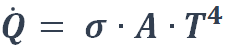
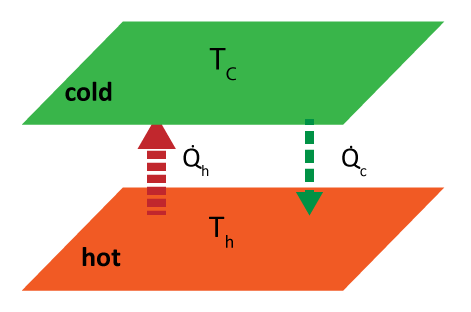
This mode of heat transfer takes place when the electromagnetic radiation emitted by two opposing surfaces are not at the same temperature. The net heat that is exchanged corresponds to the difference of the intensity of the radiation leaving the warm surface and the one leaving the colder surface. In the simplest case of two parallel black body surfaces:
Where: Q is the heat flux and the net heat transfer [W m-2] σ is the Stefan-Boltzmann constant, 5.670 373×10−8 [W·m−2·K−4] A is the area of the surface [m2] T, Th and Tc are the absolute temperatures, hot and cold. [K] |
 |
In actual, complex systems, two further parameters must be taken into account: a form factor relating the exposure of a curved surface to another one at different incidence angles, and the different emissivity of the materials of which each surface is made.
Important to remind:

Where m is the mass [kg] and Cp the specific heat [J kg-1 k-1] of the hot and cold materials.
During nights with clear sky, the cooling of the ground will be fast because there is almost no opposing surface at a slightly colder temperature. During a covered night, the clouds form a shield that is not as cold as the outer atmosphere; the net heat flux is reduced thanks to the smaller temperature difference, and it takes a longer time for the ground to cool down. This is why the morning temperature in the desert can be pretty low, colder than in a temperate and humid region. Swimming pool owners know that they need to cover the surface with an isolating sheet to prevent too much cooling during the night. But note that they should also cover it during the day, this time to prevent evaporation and loss of water. But then there would remain no time for swimming!