The climate issue is far from being resolved as some would have us believed: neither as to its sensitivity to its causes, nor to its effects, nor as to the measures to be taken, or not to be taken.
The climate has been changing continuously since the Earth first existed, and we are afraid of any change.
Being exposed to an avalanche of information and opinions from authorities claiming to tell me what to think and do, I preferred to take time to understand what is going on, and to forge my own opinion.
I propose it here in complete independence.
Whoever wants to verify what I write can do so, at the cost of time and attention. The others are kindly asked to trust me.
Please take a close look, it is far from being conventional or banal.
If this exercise helps to enlighten others, then it will have served more than once.
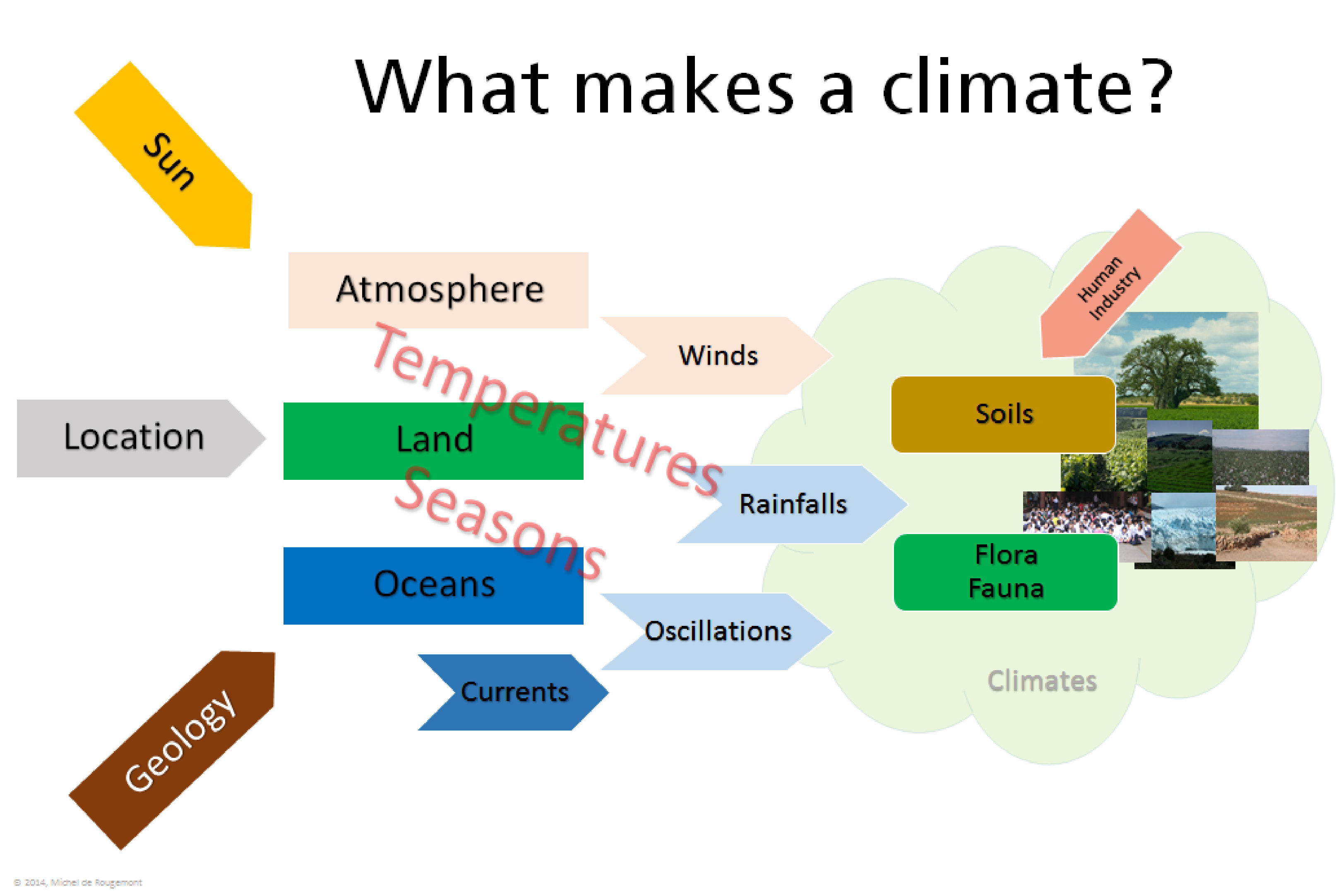
Climate can be observed by physical parameters similar to those used to characterize weather, but they must be monitored over a much longer period of time, centuries and millennia. Only statistical analyses of long series can identify whether variations indicate significant changes or not.
To understand how parameters interact, it is necessary to refer to established laws of physics and chemistry, or to propose new ones if there is sufficient evidence to establish them. In climate studies, the main focus is on matter and heat exchanges as well as on electromagnetic radiation.
Climate systems are chaotic, non-linear and highly intertwined. No single solution can be obtained by a combination of all the relevant equations. This is why models can be useful to get closer to reality and to test various scenarios. However, theyshall not be used to produce in silico narratives, to make scientific discoveries, or to serve as evidence of speculative projections into the future
The climate controversy revolves around four tenets:
The use of models to "do science" is abusive. Comparing the results of various algorithms between them only shows their differences and does not allow them to be averaged in order to establish a so-called "truth".
Overall, the models are overheating, i.e. the results of their calculations greatly exceed the instrumental observations.
Potential scenarios, up to 2100 and beyond, are defined to comparate models among themselves. They need to be plausible.
Single catastrophic events are systematically attributed to anthropogenic causes of climate change. This is an abuse of impossible statistics and a form of pseudoscience.
My personal position is neither climato-credulous nor sceptical. I categorically reject the defamatory denomination of climate denier.
I have no fundamental doubts about the observed facts and the underlying phenomena.
However, many prophecies are not plausible. There is a great contradiction between the inertia that climate systems have shown in history and the call for general mobilization for a "state of climate emergency".
The announcements of future disasters are dishonest and based on the most exaggerated and non plausible scenarios. Economists are struggling among themselves to disagree about the potential losses or gains resulting from clmate scenarios. By a mandate of the United Nations Framework Convention on Climate Change, the positive effects are systematically ignored.
Mitigation policies (first and foremost decarbonation) are being promulgated that are futile, extremely costly and also unfair in the face of the world's development priorities. Adaptation strategies should be preferred.
The vast scientific uncertainties must not be dismissed in favour of political certainties.
While it is reasonable for society to transition away from fossil fuels over time, it is illusory to impose it urgently without realistic and affordable solutions, and criminal to attempt to do so at whatever cost.
The "causa climatica" was not invented just for a few degrees of warming. It is a unique opportunity to hold all of humanity hostage for ideological purposes, not to mention fuelling new, lucrative businesses.