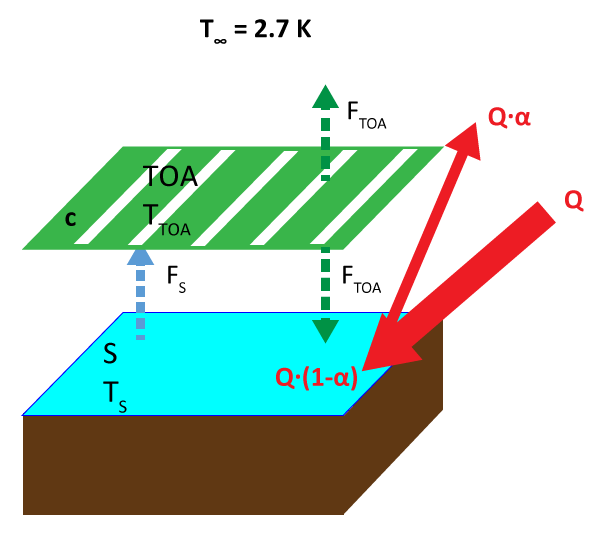
The incoming solar radiation at the earth's orbital distance is S=1366 Wm-2. On average, to account for the sphericity of the planet and its 24 h rotation, the average incident irradiation Q is one fourth of the solar constant Q = S/4.
For the two surfaces and the fluxes shown on the model picture, the energy balance is[1]:
Energy absorbed + Energy received from 2nd layer = Energy emitted at surface
 (eq. 8)
At the Top of Atmosphere
Energy received from the surface = 2 x energy emitted from TOA[2]
 (eq. 9)
Where:
Radiative Forcing ΔF can be added to these energy fluxes.
Applying the Stefan Boltzmann equation gives:
 and
and 
Solving equations 8 and 9 for FS and FTOA gives:
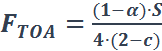 and
and 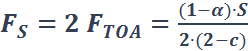 , thus
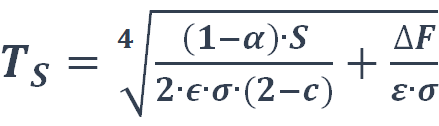 (eq. 10), and
 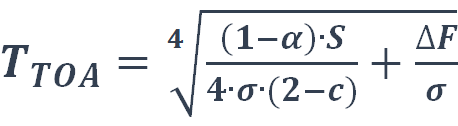 (eq. 11)
To calculate TS and TTOA , parameters must be selected within a realistic range.
With α = 0.306, ε = 0.92 at the Earth’s surface, and c = 0.66 the results are:
|
Emitted radiation |
Temperature |
||
|
K |
°C |
||
|
At the Earth’s surface, TS |
353.7 |
287.0 |
+13.8 |
|
At the top of atmosphere TTOA |
176.9 |
236.3 |
-36.8 |
Surface and Top of Atmosphere temperature
by application of eq. 10 and 11 with actual conditions
These calculated figures are quite well in line with observed values. A temperature of -37°C correspond to an altitude of 5700 m (ISA standard). The simple two layers model is therefore validated as plausible.
In this model, the surface temperature is defined by just 4 parameters. Variations of solar input are known and of cyclical nature: orbital ellipse, solar spots, Milankovitch cycles. The sensitivity of TS to these parameters can be evaluated:
Notes:
[1] For model explanations see Stocker, T., Lecture notes, “Einführung in die Klima Modellierung.“ https://climatehomes.unibe.ch/~stocker/papers/stocker08EKM.pdf
[2] It takes some explanation to understand that energy is bouncing back and forth between the surface and the emitting layer at TOA without being actually exchanged.
A thought experiment: when, in a long floor well isolated toward the exterior, two facing walls are at the same temperature, they emit the same amount of energy toward each other. On balance, they re-emit what they receive. If the temperature of one of the walls increases (e.g. by heating it from the exterior) the other one will warm until a new equilibrium is reached. The first thermodynamic principles is respected.